Character creation survival statistics
home page
The Traveller game in all forms is owned by Far Future Enterprises.
Copyright 1977 – 2022 Far Future Enterprises. Traveller is a registered
trademark of Far Future Enterprises. Far Future permits web sites and
fanzines for this game, provided it contains this notice, that Far Future
is notified, and subject to a withdrawal of permission on 90 days notice.
The contents of this page are for personal, non-commercial use only. Any
use of Far Future Enterprises’s copyrighted material or trademarks anywhere
on this web page and its file should not be viewed as a challenge to those
copyrights or trademarks. In addition, this program/file on this site cannot
be republished or distributed without the consent of the author who
contributed it.
Link to the Python3 script on github.com used to generate the character creation survival statistics used for the charts below.
This python3 script runs through character creation rules from the Traveller Little Black Book (LBB) 1 (1981) Characters and Combat.
It is an attempt to determine the likelihood of a character surviving character creation for particular careers.
It also generates a numbers of runs that gained a number of benefits for each term on failing reenlistment.
It follows some simple logic:
- for each run the charactistics are randomly generated
- for each term if reenlistment is succesful then the run continues to the next term i.e. no option to voluntarily muster out is given
- if more than one skill is awarded in any term then one role (at least) is made on the personal development table
Enlistment
A set of results for one million runs against each career indicate the likelihood of enlisting as:
| service | likelihood of enlistment |
| navy | 56 % |
| marines | 46 % |
| army | 98 % |
| scouts | 77 % |
| merchant | 82 % |
| other | 97 % |
Charts
The following graphs indicate the likelihood of survival during character generation and the probable number of benefits received on mustering out due to failed reenlistment (which indicates Rank at end of service career and so some indication of likelihood of commision and promotion during the service career).
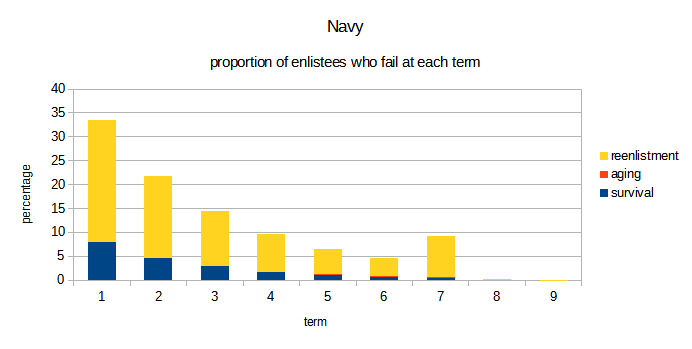
This graph indicates the reason for leaving the service at each term as a percentage (to two significant figures) of those that successfully enlist
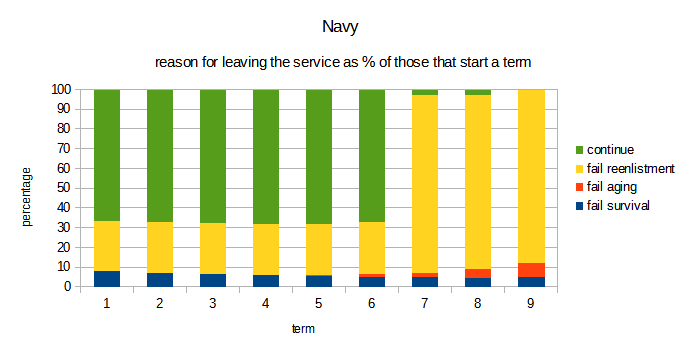
This graph indicates the proportion of those who start each term which continue to the next term, fail to reenlist, fail due to aging during that term or fail survival during that term.
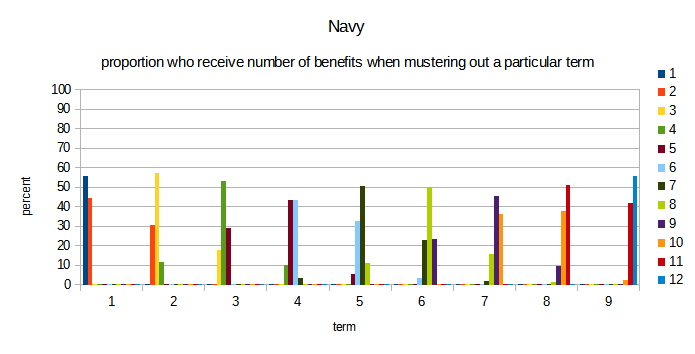
This graph shows the number of mustering out benefits received for those that fail reenlistment at each term
Probably the cross-over points are most interesting. The cross-over from Terms +1 benefit to Terms +2 benefits which occurs at term 4, that is more Navy characters that make it to term 4 have Rank 3 or 4 than those without commision or Ranks 1, 2 (or 5). The cross-over from Terms +2 to Terms +3 where the majority of Navy characters have Rank 5 or 6 occurs at Term 8 (which is after retirement age, i.e every character here has rolled double 6 on reenlistment approximately one in a thousand)
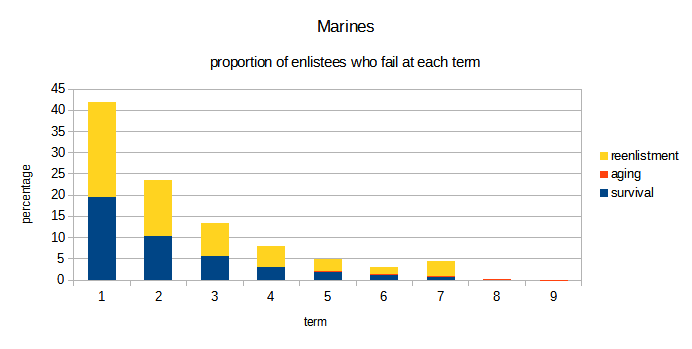
This graph indicates the reason for leaving the service at each term as a percentage (to two significant figures) of those that successfully enlist
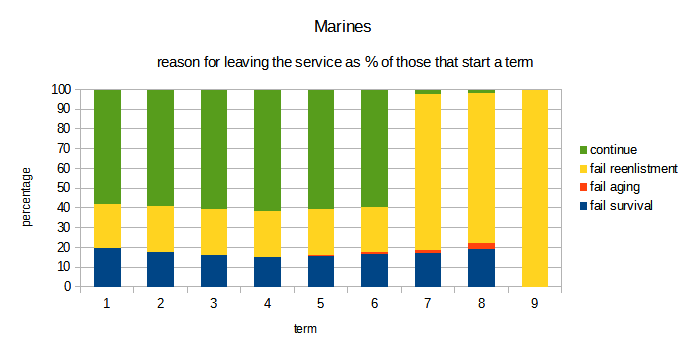
This graph indicates the proportion of those who start each term which continue to the next term, fail to reenlist, fail due to aging during that term or fail survival during that term.
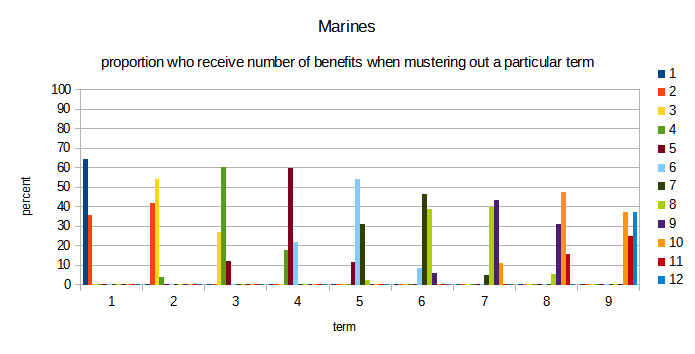
This graph shows the number of mustering out benefits received for those that fail reenlistment at each term
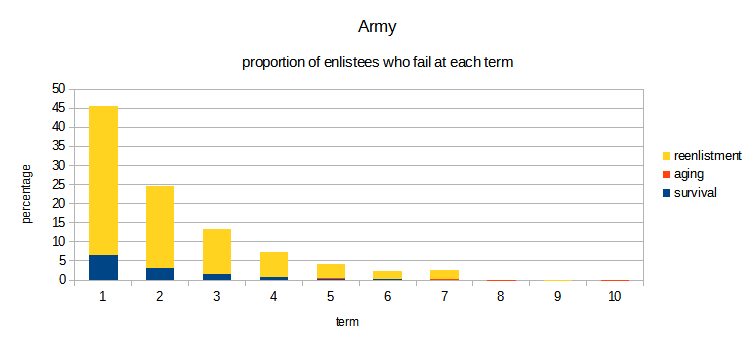
This graph indicates the reason for leaving the service at each term as a percentage (to two significant figures) of those that successfully enlist
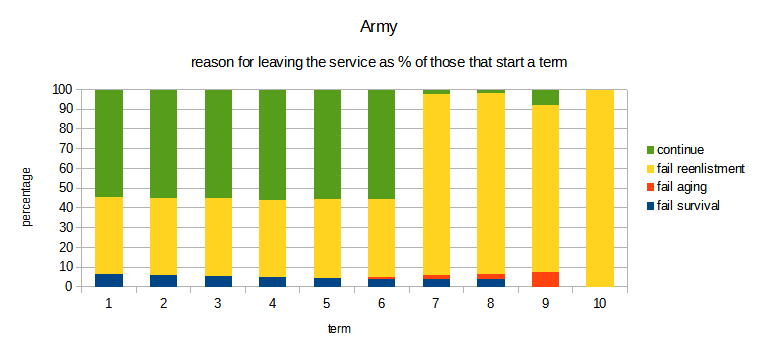
This graph indicates the proportion of those who start each term which continue to the next term, fail to reenlist, fail due to aging during that term or fail survival during that term.
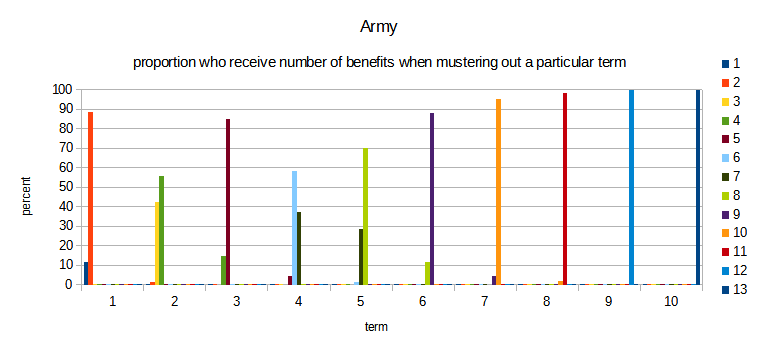
This graph shows the number of mustering out benefits received for those that fail reenlistment at each term
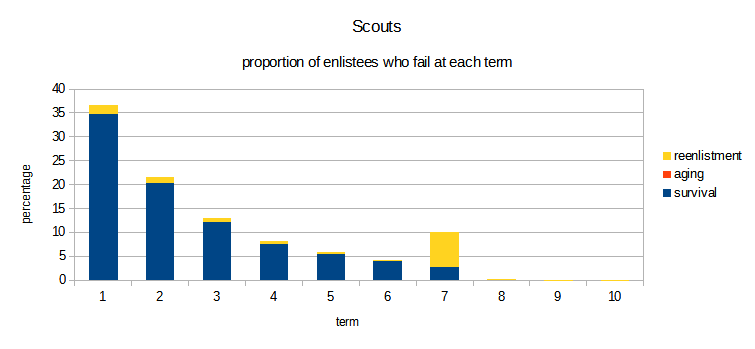
This graph indicates the reason for leaving the service at each term as a percentage (to two significant figures) of those that successfully enlist
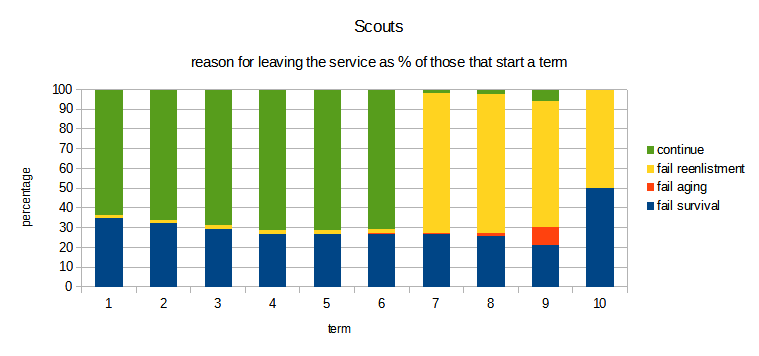
This graph indicates the proportion of those who start each term which continue to the next term, fail to reenlist, fail due to aging during that term or fail survival during that term.
The chance of failing reenlistment is very low but about a third do not survive each term, being a Scout is tough.
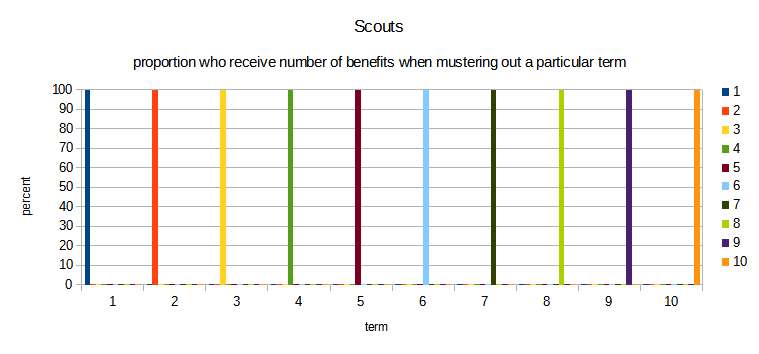
This graph shows the number of mustering out benefits received for those that fail reenlistment at each term
As Scouts have no Rank structure, benefits are as expected, equalling number of Terms of service for all. Though each benefit is probably greater than other services and it gives the highest likelihood of gaining ship shares as all Scouts have a one-in-six chance for each roll on the benefits (vis cash) table, otherwise only Merchant Captains have a chance at ship shares.
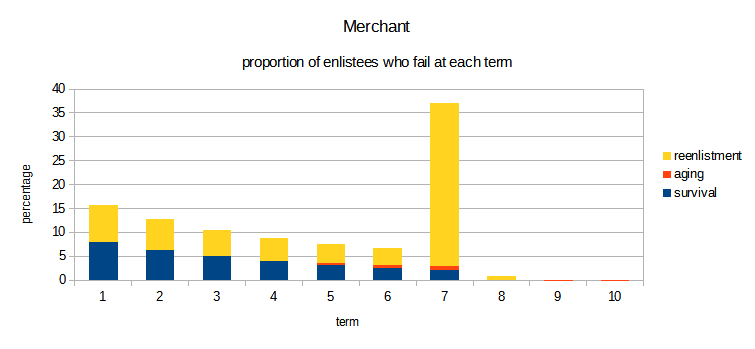
This graph indicates the reason for leaving the service at each term as a percentage (to two significant figures) of those that successfully enlist
About a third who start a Merchant career make it to retirement (fail reenlistment at term 7).
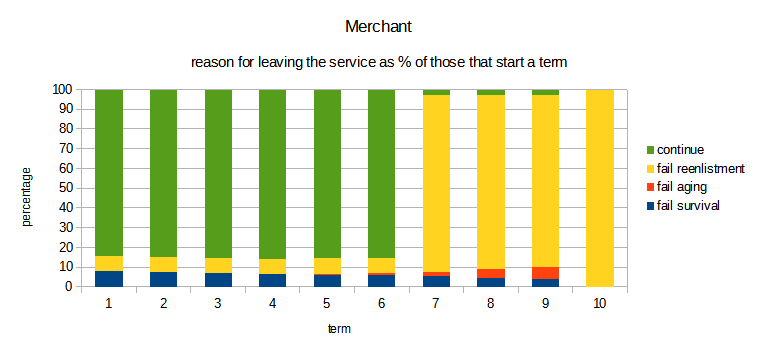
This graph indicates the proportion of those who start each term which continue to the next term, fail to reenlist, fail due to aging during that term or fail survival during that term.
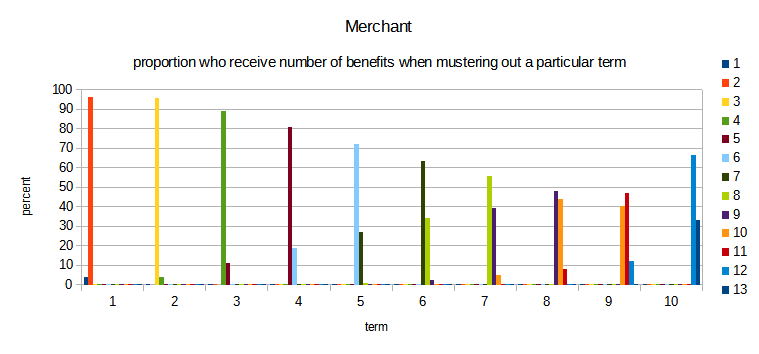
This graph shows the number of mustering out benefits received for those that fail reenlistment at each term
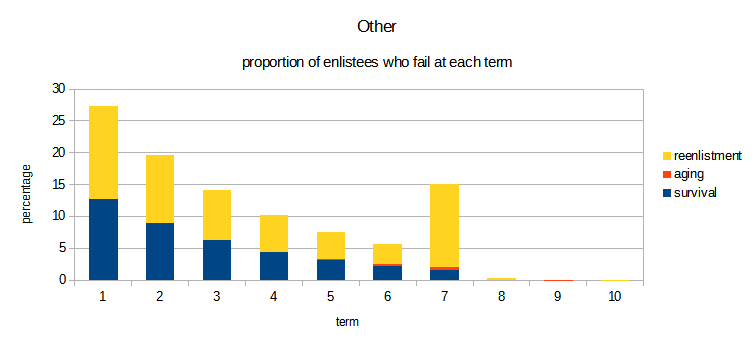
This graph indicates the reason for leaving the service at each term as a percentage (to two significant figures) of those that successfully enlist

This graph indicates the proportion of those who start each term which continue to the next term, fail to reenlist, fail due to aging during that term or fail survival during that term.
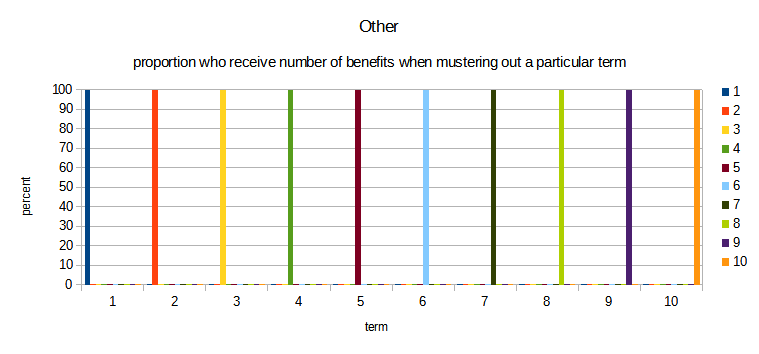
This graph shows the number of mustering out benefits received for those that fail reenlistment at each term
As with Scouts, Other has no Rank structure and so benefits are as expected, equalling number of Terms of service for all.
The Traveller game in all forms is owned by Far Future Enterprises.
Copyright 1977 – 2022 Far Future Enterprises. Traveller is a registered
trademark of Far Future Enterprises. Far Future permits web sites and
fanzines for this game, provided it contains this notice, that Far Future
is notified, and subject to a withdrawal of permission on 90 days notice.
The contents of this page are for personal, non-commercial use only. Any
use of Far Future Enterprises’s copyrighted material or trademarks anywhere
on this web page and its file should not be viewed as a challenge to those
copyrights or trademarks. In addition, this program/file on this site cannot
be republished or distributed without the consent of the author who
contributed it.